Descriptions How to Install a Data Network in your House: Solving Broadband Problems, Installing a Patch Panel, Cabling Data Sockets, Installing a Patch Panel book

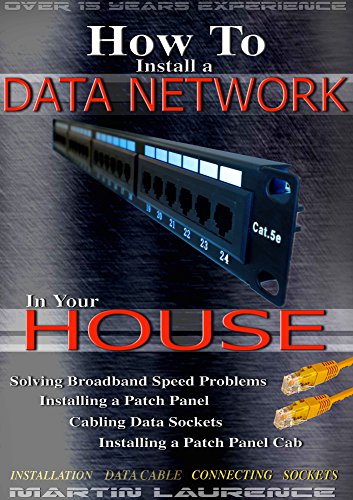
--NEW UPDATE FEB 7th 2016 -- COMPLETE WITH PICTURES PLUS GREAT INFORMATION -- Do you have chronically slow Broadband? Is your Laptop and Computer taking ages to send files, pictures and watch Films?
Did you know Wi-Fi is 50% SLOWER than hard-wired networks? Thick walls, ceilings, and metal beams can all have a detrimental effect on your broadband speed. It can actually be a LOT slower depending on your house architecture.
So rather than hammering down the motorway on your Broadband speed you're driving down a narrow road, full of speed bumps behind a learner driver.
I had terribly slow internet speed due to using Wi-Fi for all my various machines in my house. Not only that i wanted to use a laptop in the garage - that was out of range and totally hopeless!
This is where a hard-wired network - cabled from the Router to specific points in your house where you want the internet will defeat Wi-Fi every single time.
The Stats:
--Wi-Fi can be as slow as 300mbps right down to 54mbps
--Hard-Wired Cat5e Cable can be as fast as 1000mbps
--Hard-Wired Cat6A Cable an be as fast as 10,000mbps
In plain speak - hard-wiring from your Router to your PC/Mac maximizes your broadband speed. It's a direct connection to each of your computers. We're getting rid of the speed bumps and getting you on that motorway.
Being a Telecommunications Engineer of 15 years made this a relatively easy job for myself and I wanted to share with you the method of doing this by creating this book. I felt my experience would be really useful to a great many people and this led to me writing this book.
The first thing you wondering is that it's too complicated, 'techy' and you don't have any of the tools or equipment to do this? Why this book?
It's simply. Start to finish, from screwdriver to final test and I include lots of pictures of tools and ideals of how to cable plus connections on the sockets and patch panel.
1) I'm saving you hundreds of pounds/dollars etc to get in engineers in to do the work - when i can help you do it yourself.
2) I cover all the tools that you will need. You may have a some of the tool's already from screwdrivers, to a hammer and a step ladder. I also go through the Cable type that you'll need and the type of sockets/outlets you can use. These things are pretty inexpensive and available from most hardware/online shops.
3) I go through where you want your new sockets and what to look for in terms of cabling. Knowing what to look for can make a huge difference to making this an easy job and a hard job, we can look at the 'cheats' to make the job as easy as possible. Again this isn't rocket-science - i'll take you through what to look for SAVING you massive amounts of time.
4) I take you through the cabling, we don't want to see horrible tram-lining cables, right? So we're going to cable through the neatest routes. We can look in the basement, the attic, but we also need to get down the exterior walls - which i also have a great trick for making this invisible. I'll help you achieve this.
5) I'll take you through connecting up your new sockets, connecting the patch panel and whether a cabinet is best for you.
6) I'll take you through scanning the network and finally patching out.
There's lots of tricks and cheats to making the most of your house to make the neatest job.
My book is FULL of helpful pictures - here are the chapters i cover everything from:
--Equipment needed
--Where to situate the hub and Patch Panel
--Cabling the Line to the Router
--Cabling the Network
--Hiding the Cabling
--Connecting the Sockets
--Patch Panel or RJ45 Ends?
--Scanning the network
I wanted to give someone a simple ''How to'' - I’m going to throw the guff and tech-talk out the window – it’ll be an easy to follow guide with no nonsense.
Let’s max out that super speed from your Internet and get cabling!, 4Th Grade Reading Books .
CLICK HERE TO DOWNLOAD THIS BOOK FOR FREE