Descriptions Arguing A.I.: The Battle for Twenty-first-Century Science Free Online

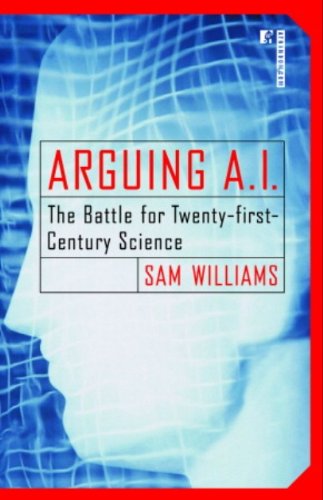
Few scientific topics since the theory of biological evolution have inspired as much controversy as artificial intelligence has. Even now, fifty years after the term first made its appearance in academic journals, many philosophers and more than a few prominent scientists and software programmers dismiss the pursuit of thinking machines as the modern-day equivalent of medieval alchemists’ hunt for the philosopher’s stone-a pursuit based more on faith than on skeptical inquiry.
In Arguing A.I., journalist Sam Williams charts both the history of artificial intelligence from its scientific and philosophical roots and the history of the A.I. debate. He examines how and why the tenor of the debate has changed over the last half-decade in particular, as scientists are struggling to take into account the latest breakthroughs in computer science, information technology, and human biology. For every voice predicting machines like 2001’s HAL within the next twenty to thirty years, others have emerged with more pessimistic forecasts. From artificial intelligence’s pioneers John McCarthy and Marvin Minsky, to futurist authors Ray Kurzweil and Hans Moravec, to software architects Bill Joy and Jaron Lanier, Arguing A.I. introduces readers to the people participating in the current debate, both proponents and critics of A.I. who are changing the way computers “think” and the way we think about computers.
Ultimately, Arguing A.I. is as much a history of thought as it is a history of science. Williams notes that many of the questions plaguing modern scientists and software programmers are the same questions that have concerned scientists and philosophers since time immemorial: What are the fundamental limitations of science and scientific inquiry? What is the nature of intelligence? And, most important, what does it really mean to be human?The drive to create artificial intelligence has been contentious since its beginnings, and the arguments have sharpened our understanding of fields as diverse as mathematics, neuroscience, and philosophy. Arguing A.I.: The Battle for Twenty-First Century Science, a brief history of the controversies by science writer Sam Williams', is an excellent starting point for readers interested in arguments more than circuit diagrams.
Its six chapters are strongly focused, if occasionally in curious directions; for example, while Jaron Lanier is no doubt an important figure, he gets a surprising and disproportionate amount of page space. Still, Williams defines and clarifies the debates over the feasibility and desirability of A.I. and includes plenty of resources on paper and online to inspire further investigation. --Rob LightnerFew scientific topics since the theory of biological evolution have inspired as much controversy as artificial intelligence has. Even now, fifty years after the term first made its appearance in academic journals, many philosophers and more than a few prominent scientists and software programmers dismiss the pursuit of thinking machines as the modern-day equivalent of medieval alchemists’ hunt for the philosopher’s stone-a pursuit based more on faith than on skeptical inquiry.
In Arguing A.I., journalist Sam Williams charts both the history of artificial intelligence from its scientific and philosophical roots and the history of the A.I. debate. He examines how and why the tenor of the debate has changed over the last half-decade in particular, as scientists are struggling to take into account the latest breakthroughs in computer science, information technology, and human biology. For every voice predicting machines like 2001’s HAL within the next twenty to thirty years, others have emerged with more pessimistic forecasts. From artificial intelligence’s pioneers John McCarthy and Marvin Minsky, to futurist authors Ray Kurzweil and Hans Moravec, to software architects Bill Joy and Jaron Lanier, Arguing A.I. introduces readers to the people participating in the current debate, both proponents and critics of A.I. who are changing the way computers “think” and the way we think about computers.
Ultimately, Arguing A.I. is as much a history of thought as it is a history of science. Williams notes that many of the questions plaguing modern scientists and software programmers are the same questions that have concerned scientists and philosophers since time immemorial: What are the fundamental limitations of science and scientific inquiry? What is the nature of intelligence? And, most important, what does it really mean to be human?, Read Kindle Books On Pc .
CLICK HERE TO DOWNLOAD THIS BOOK FOR FREE